 Tom Moulton··Strategy·7 min read
Adoption is not the achievement. The number is
More than half of UK firms now use AI, yet few can name the number it moved. Measurement, not adoption, is the line that now separates the businesses getting a return from the ones quietly wasting money.
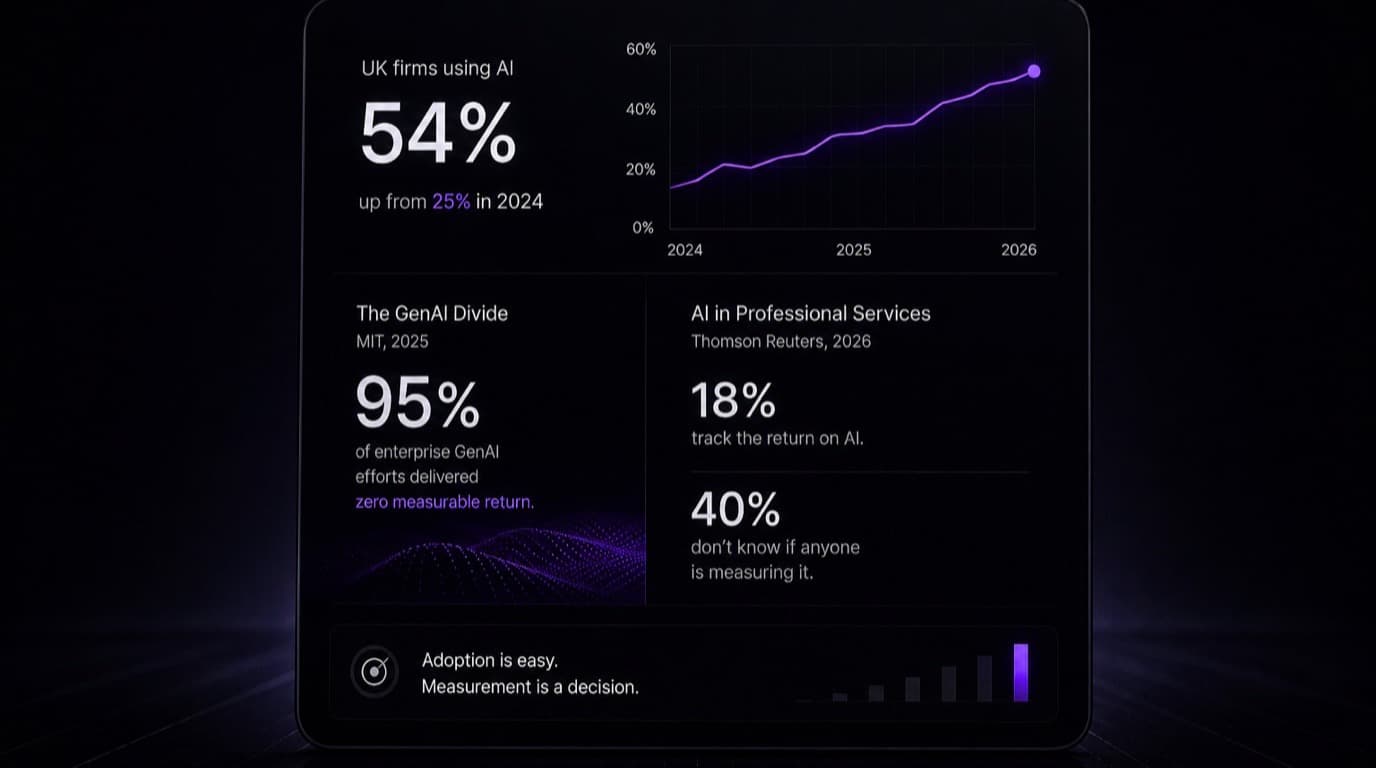
Half of British businesses now use AI. That is no longer the interesting fact. The interesting fact is that most of them cannot tell you what it changed, and a worrying number have never tried to find out.
Adoption used to be the headline. Back in 2024 it felt like progress just to have a licence and someone brave enough to use it. That moment has passed. Research published in March 2026 by the British Chambers of Commerce, with Atos, found that 54% of UK firms are now actively using AI, up from 35% in 2025 and just 25% in 2024.1britishchambers.org.ukHalf of SMEs using AI, with limited headcount impact so farBritish Chambers of Commerce, with Atos, March 2026Visit source → In accountancy and law, use is closer to universal. Getting your hands on the technology is no longer the achievement. It is table stakes.
Here is the uncomfortable truth underneath the adoption figures. Using AI and getting a return from AI are two completely different things, and the gap between them is where most of the money is quietly going to waste.
The stat everyone quotes, and the one they should
You have probably seen the MIT number by now. In The GenAI Divide: State of AI in Business 2025, MIT's Project NANDA found that 95% of enterprise generative AI efforts delivered zero measurable return, drawn from 52 executive interviews, surveys of 153 senior leaders, and an analysis of more than 300 public deployments.2mlq.aiThe GenAI Divide: State of AI in Business 2025MIT Project NANDA, July 2025Visit source →
It got quoted everywhere, usually as proof that AI is overhyped. That is the wrong lesson. The models were rarely the problem. The failures came down to how the work was scoped and deployed: pilots that were never wired into a real workflow, never measured against a baseline, and never given a number to hit.
The stat that should worry you more is a quieter one. The Thomson Reuters Institute's 2026 AI in Professional Services Report, drawing on more than 1,500 professionals, found that only 18% say their organisation tracks the return on AI at all, and 40% do not know whether anyone is measuring it.3thomsonreuters.com2026 AI in Professional Services ReportThomson Reuters Institute, 2026Visit source → Read those two findings together and the picture is bleak. Most organisations are spending money on AI, and most of them have no idea whether it is working.
That is not an adoption problem. It is a measurement problem. And it is entirely fixable.
"We're using AI" is a sentence that means nothing
When a business tells me it is using AI, I have learned to ask one question: what number has it moved? Hours saved on a specific process. Cost per case. Turnaround time on an enquiry. Error rate on a document. Most of the time, there is a pause.
That pause is the whole story. A subscription is not a strategy, and a tool your team occasionally opens is not a system. If you cannot state the metric it changed, you have not adopted AI in any sense that shows up in your accounts. You have bought a subscription and hoped.
The businesses genuinely ahead are not the ones with the biggest platform or the longest list of tools. They are the ones who can point at a process, tell you exactly what it cost before, and tell you exactly what it costs now.
Beware the agent that isn't one
There is a second trap running through the market right now, and it has a name. Gartner calls it agent washing: vendors rebranding old automation, chatbots and rules engines as AI agents without any genuine agentic capability underneath. Gartner has gone as far as predicting that over 40% of agentic AI projects will be cancelled by the end of 2027, citing escalating costs, unclear business value and inadequate risk controls, and it estimates that only around 130 of the thousands of self-styled agentic vendors are the real thing.4gartner.comGartner Predicts Over 40% of Agentic AI Projects Will Be Canceled by End of 2027Gartner, June 2025Visit source → It has also found that just 17% of organisations have actually deployed AI agents so far, against more than 60% who intend to within two years.5gartner.com2026 Hype Cycle for Agentic AIGartner, 2026Visit source →
For a professional services firm, an accountant, a solicitor, a recruiter, a haulier, this matters more than it might sound. You are exactly the buyer these labels are aimed at. You have repetitive, document-heavy, rule-bound work that looks perfect for automation, and you are busy enough that a slick demo is tempting.
So ask the harder question. Not does it have AI in it, but what does it actually do, on my data, and how will we know it worked? A demo is easy to stage. A measured result on your real work is not. The difference between the two is the difference between spending money and making it.
Why the big transformation programme is the wrong shape
The instinct, once a business decides AI matters, is to go big. A strategy. A steering group. A twelve-month roadmap with a workstream for every department. I understand the pull. It feels serious and it feels safe. It is neither.
Big AI programmes fail for the same reason big software programmes always have. They commit budget before they have proven value, they scope at the level of the whole business rather than a single job, and by the time anything ships the assumptions it was built on have moved. You find out whether it works right at the end, which is the most expensive possible moment to find out.
The organisations getting a return do the opposite, and it looks almost embarrassingly modest. They start smaller than feels ambitious. One process. One measurable job. The simplest system that could handle it. They prove the number, then they move to the next thing.
Start narrow, measure honestly, expand only what works. It is not the exciting version. It is the one that pays.
Audit before you build, prove it before you scale
Two disciplines make the difference, and neither is glamorous. The first is knowing what to fix before you spend a penny building. Most projects fail because they start with a solution and go looking for a problem. Half the value of a proper discovery exercise is in the builds it talks you out of: the six-figure system you did not need because the real leak was upstream, re-keyed by hand across three tools. Finding out where the hours actually go, and where AI genuinely earns its place, is cheap insurance against an expensive mistake.
The second is refusing to call anything a success until it has beaten a baseline. Agree the single number that defines working, in writing, before the build starts. Measure where you are today. Build the smallest thing that moves that number. Then run it on real work and check. If it hit the number, it earned its place. If it did not, you kill it, having spent very little finding out.
This is why we build the way we do. A time-boxed pilot on one painful process, on your real data, measured against a baseline you agreed at the start, beats a transformation deck every time, because at the end you are holding evidence rather than assertions.
The businesses that will look back on this year as the one that mattered are not the ones that adopted the most AI. They are the ones that measured it, killed what did not work, and kept the handful of things that did. Everyone is using AI now. Very few can tell you what it changed. Be one of the few.
References
- 1Half of SMEs using AI, with limited headcount impact so far — British Chambers of Commerce, with Atos, March 2026
- 2The GenAI Divide: State of AI in Business 2025 — MIT Project NANDA, July 2025
- 32026 AI in Professional Services Report — Thomson Reuters Institute, 2026
- 4Gartner Predicts Over 40% of Agentic AI Projects Will Be Canceled by End of 2027 — Gartner, June 2025
- 52026 Hype Cycle for Agentic AI — Gartner, 2026
Ready to see what we could build for your business?
Talk through a new build on a free discovery call, or find where AI pays back with an AI Opportunity Audit.